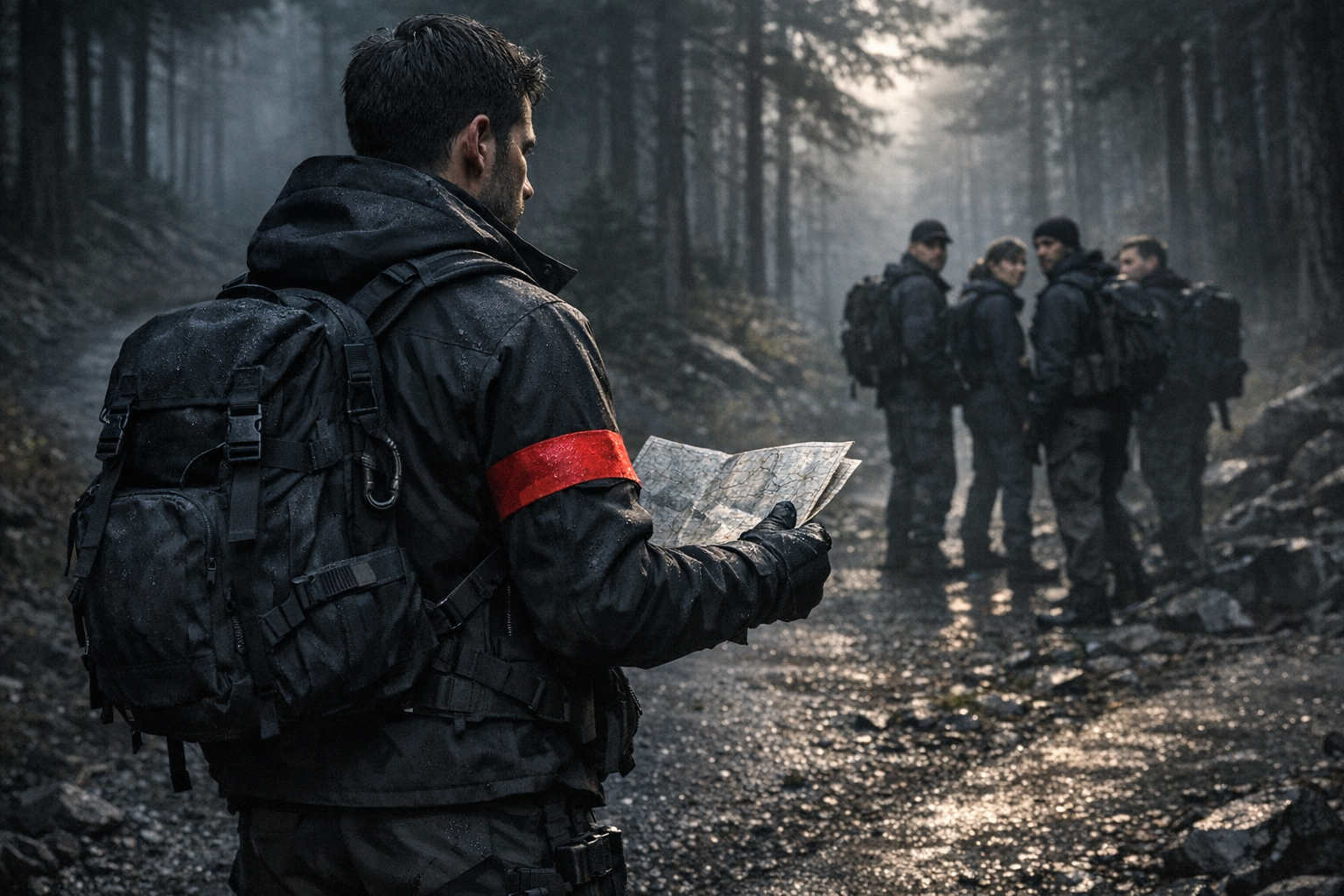
When facing a survival scenario, one of the most critical decisions is whether to go solo or work with a group. Each choice has clear advantages and drawbacks, and the right approach depends on your situation, skills, and goals. Here's the breakdown:
- Solo Survival: Offers freedom, stealth, and simpler resource management. However, it demands full self-reliance, increases vulnerability during rest, and can take a toll on mental health due to isolation.
- Group Survival: Provides safety in numbers, shared responsibilities, and diverse skills. But it requires more resources, moves slower, and can be complicated by interpersonal conflicts.
Key Takeaway: Solo survival is ideal for quick, stealthy movements, while group survival works best for long-term stability and shared workloads. Your choice should align with your environment, physical abilities, and mental resilience.
Quick Comparison
| Factor | Solo Survival | Group Survival |
|---|---|---|
| Mobility | Fast and discreet | Slower, easier to spot |
| Security | Vulnerable while resting | Shared watch duties |
| Resources | Lower consumption, limited capacity | Higher consumption, shared supplies |
| Skills | Limited to personal knowledge | Diverse skill sets |
| Mental State | Risk of loneliness | Emotional support from others |
| Injury Handling | High risk with no help | Group can assist and share the load |
Both paths have trade-offs, so weigh your options carefully to prepare for any scenario.
@figure 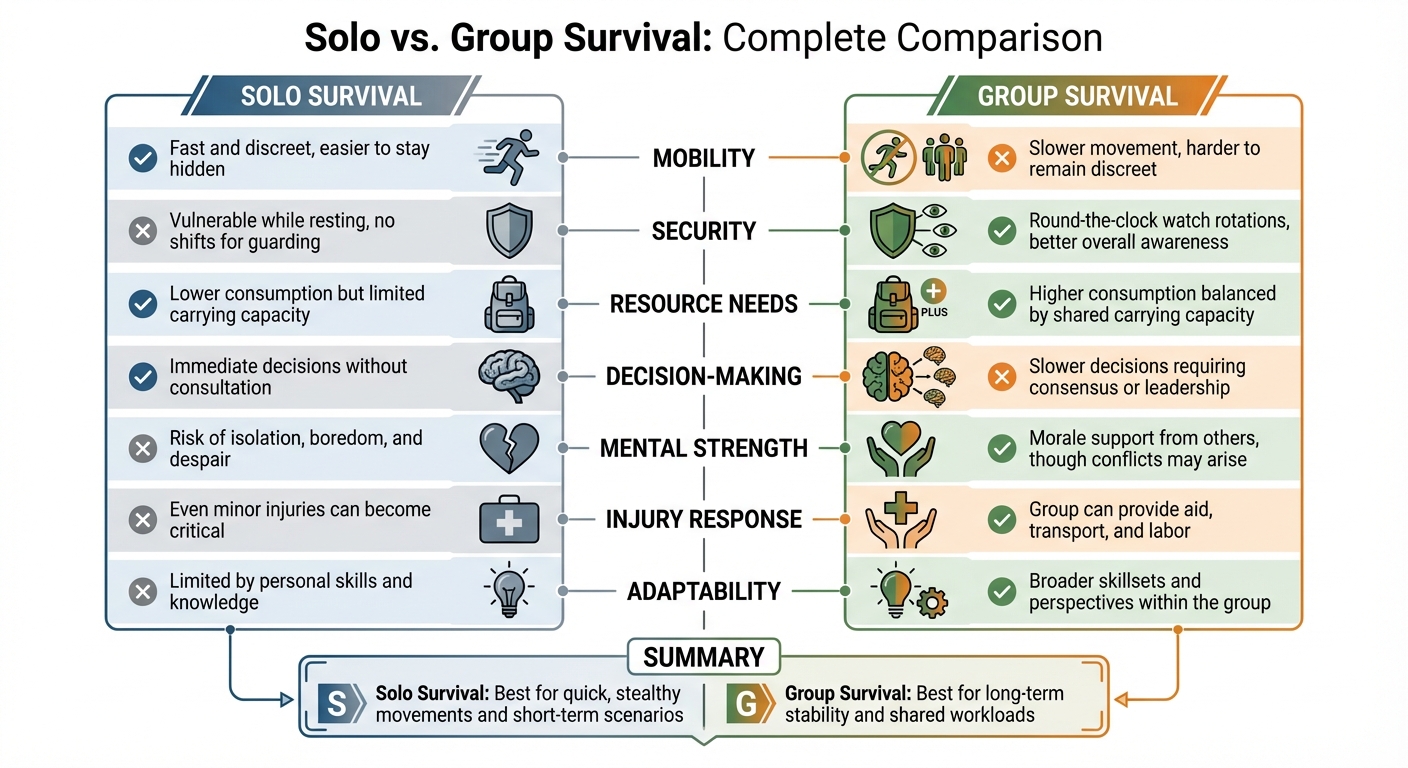 {Solo vs Group Survival Comparison Chart}
Solo Survival: Pros and Cons
Surviving alone offers unmatched freedom and flexibility, but it also places the entire burden of survival squarely on your shoulders.
Advantages of Solo Survival
One of the biggest upsides of going solo is complete control. Every decision is yours to make - quickly and without debate. As survival consultant Tom Marlowe points out:
"Reacting to new information or emergencies will not be done by a committee, and execution will be quicker".
This level of autonomy allows you to adapt instantly to changing conditions, whether it's shifting your route, relocating your shelter, or deciding when to rest.
Another key benefit is simplified resource management. When you're on your own, you only need to account for your own needs. Food, water, and ammunition calculations are straightforward, with no need to divide supplies among a group. Andrew Skurka, an expert solo adventurer with over 30,000 solo miles under his belt, suggests packing food with a calorie density of 125 to 150 calories per ounce for maximum efficiency. Without the strain of supporting others, your resources stretch further, and you're not dealing with the added pressure of a group's demands on limited supplies like medical gear or ammunition.
Stealth and speed are natural advantages for solo survivalists. A single person moves more quietly, leaves a smaller footprint, and is far less likely to attract attention than a group. You can set your own pace - resting when needed and pushing forward when conditions allow. Plus, there's no risk of interpersonal conflict. You won't face arguments, power struggles, or betrayals that can disrupt group dynamics. It's just you, your instincts, and your plan.
However, while the benefits are clear, the challenges of solo survival are equally significant.
Disadvantages of Solo Survival
The biggest drawback of solo survival is the demand for complete self-reliance. Every task - building shelter, maintaining fire, purifying water, foraging, and ensuring security - falls entirely on you. This constant workload can quickly lead to exhaustion, especially in high-stress situations. Without anyone to share the burden, even routine tasks become physically and mentally draining.
Security is another major vulnerability. Without a group to share watch duties, you're exposed to threats - both human and animal - whenever you're asleep or distracted gathering supplies. As Tom Marlowe warns:
"A relatively small injury that is trivial for a group to accommodate or work around could be a show-stopper, and thusly spell death for a solo prepper".
Injuries like a sprained ankle, a high fever, or a deep cut that would be manageable with help can become life-threatening when you're alone. Additionally, you're limited by what you can physically carry, which means long-term survival may require pre-planning, such as setting up survival caches along your route.
The psychological toll of isolation is another hurdle. Being alone for extended periods can lead to "survival boredom", a mental state that can break even seasoned survivalists. Survival instructor Tony Nester explains:
"Loneliness and despair heightened, in my opinion, when you are not able to commiserate with and receive support from others".
Without someone to share the experience or validate your decisions, the mental strain can become overwhelming. Establishing a structured daily routine or keeping a journal can help you stay focused and reduce anxiety, but enduring long stretches of solitude requires immense mental resilience.
These challenges highlight the stark realities of solo survival, setting the stage for a deeper look at the dynamics of group survival in the next section.
Group Survival: Pros and Cons
Group survival offers the advantage of shared responsibilities but introduces its own set of challenges.
Advantages of Group Survival
One of the biggest upsides is sharing the workload. As adventurer and filmmaker Les Stroud explains:
"Many hands make light work... If a shelter must be built, it's now 400% easier to do so."
Tasks like constructing shelters or processing food that might take a solo survivor days can be tackled in just hours by a group.
Another major perk is the ability to set up security rotations. While someone surviving alone has to stay alert at all times, groups can organize round-the-clock watch shifts, allowing members to rest without compromising safety.
Groups also thrive on diverse skill sets. Disaster preparedness expert Jim Cobb highlights this point:
"Planning to go it solo in the long term is planning to fail."
A well-rounded group might include individuals with expertise in areas like medicine, hunting, mechanics, or agriculture. This diversity ensures that essential tasks are handled by those who know what they’re doing. It also provides a safety net - if one person becomes sick or injured, others can step in. In cold environments, groups can even share body heat to combat extreme temperatures.
Lastly, being part of a group can ease the psychological burdens of isolation. The social interaction helps maintain morale, which is critical in high-stress situations.
But these benefits don’t come without trade-offs.
Disadvantages of Group Survival
The most obvious downside is the increased consumption of resources. Groups go through food, water, and medical supplies much faster, which can quickly become a problem in resource-scarce environments.
Another issue is mobility. Groups tend to move slower and are less discreet, leaving behind larger tracks that can attract unwanted attention.
Perhaps the most challenging aspect is managing interpersonal dynamics. Survival expert Tom Marlowe emphasizes this risk:
"The first time you see how a member handles stress, lack, pain or adversity must not be a live event. An emotional meltdown can easily lead to disaster dominoes: a spiraling circle of enmity, even violence."
Poor leadership, unclear roles, or unchecked stress can lead to panic, resentment, and even conflict. Without clear communication and structure, these issues can escalate, jeopardizing the entire group’s survival.
Solo vs. Group Survival: Side-by-Side Comparison
When deciding between going it alone or sticking with a group, it’s helpful to break things down and see how each option measures up. The table below highlights key differences between solo and group survival, showing how the dynamics shift depending on the situation.
| Factor | Solo Survival | Group Survival |
|---|---|---|
| Mobility | Quick and stealthy; easier to stay hidden. | Slower movement; harder to remain discreet. |
| Security | No shifts for guarding; vulnerable while sleeping. | Round-the-clock watch rotations; better overall awareness. |
| Resource Needs | Lower consumption but limited carrying capacity. | Higher consumption balanced by shared carrying capacity. |
| Decision-Making | Immediate decisions without consultation. | Slower decisions requiring consensus or leadership. |
| Mental Strength | Risk of isolation, boredom, and despair. | Morale support from others, though conflicts may arise. |
| Injury Response | Even minor injuries can become critical. | Group can provide aid, transport, and labor. |
| Adaptability | Limited by personal skills and knowledge. | Broader skillsets and perspectives within the group. |
Solo survival thrives on speed and independence, making it ideal for quick getaways or stealthy navigation. However, this freedom comes at a cost - fatigue, illness, or injury can quickly turn into major setbacks. On the other hand, group survival trades some mobility and stealth for increased security, shared resources, and a wider range of skills to tackle challenges.
Ultimately, the best choice depends on your skills, the environment you’re navigating, and how long you expect the situation to last. Each approach has its strengths and weaknesses, and the right one will hinge on the specific circumstances you face.
sbb-itb-1666494
AgentXSurvival Gear for Solo and Group Scenarios
Whether you're braving the wild alone or tackling challenges with a team, the right gear can make all the difference. AgentXSurvival offers carefully selected resources to suit both solo and group survival situations, helping you address the specific demands of each approach. The right equipment can amplify your strengths and offset potential weaknesses.
Gear for Solo Survival
When you're navigating survival on your own, mobility and efficiency are key. Lightweight, multifunctional tools are essential. A compact multitool and a fire starter are must-haves - they cover crucial tasks like cutting, repairs, and starting fires, all while keeping your gear manageable and discreet.
Portable water filters are another solo survival staple. Instead of lugging heavy water containers, a reliable filter allows you to purify water on the go, ensuring hydration without adding unnecessary weight.
Survival caches are a smart strategy for solo adventurers. By stashing emergency supplies - like MREs, water, and hygiene essentials - along your planned route to a bug-out location, you can access critical resources without overburdening yourself from the outset.
Additionally, a well-stocked first aid kit and compact technical manuals are indispensable. When you're on your own, even a minor injury can become a major obstacle. Self-treatment supplies, coupled with guides on medical care, edible plants, and basic repairs, can help you handle challenges effectively when there's no backup nearby.
Gear for Group Survival
Surviving as a group requires a different approach, focusing on shared resources and teamwork. Solar-powered systems and large-scale water filtration setups are ideal for supporting multiple people. These solutions allow the group to pool resources, lightening the load for individuals while ensuring collective needs are met.
Communication is another cornerstone of group survival. Emergency radios and group alert systems are vital for keeping everyone informed and coordinated during a crisis. Quick and clear communication can make all the difference when it comes to safety and decision-making.
For defense and security, groups have the advantage of shared responsibilities. Pooling firearms, ammunition, and tools for perimeter security enhances overall safety. Cross-training team members in medical care and other critical skills ensures the group remains functional, even if a key member is injured or unavailable.
AgentXSurvival's resources include bulk food storage kits, the DIY Aqua Tower water generator, and detailed guides for assigning roles like Medic, Scout, and Organizer. These tools and strategies promote effective collaboration, ensuring that every team member plays a vital role in the group's survival plan.
How to Choose Between Solo and Group Survival
Your decision to go solo or stick with a group depends on your situation, skills, and the challenges you face. If you're navigating through hostile areas or need to move swiftly while staying under the radar, going solo - or teaming up with just one other person - can be the smarter choice. Solo survival allows for quicker travel and immediate decision-making without needing to consult others. On the flip side, if you're planning to stay put on a homestead or live off-grid for an extended period, a group becomes essential. Tasks like farming, setting up security rotations, and gathering resources require more hands. Weigh these factors, along with the earlier pros and cons, to make an informed decision.
Trust plays a huge role in whichever path you choose. Going solo removes the risk of betrayal but leaves you exposed during moments of rest or emergencies. In a group, trust is the glue that holds everything together. As one expert puts it:
"Trust is the most precious currency you can have circulating in your survival group".
Without trust, group dynamics can fall apart quickly, creating more problems than solutions.
Your leadership style and ability to follow directions also matter. Successful groups thrive under clear leadership, where someone can handle disputes, make tough calls, and keep everyone focused. If you're not comfortable resolving conflicts or taking orders when needed, group survival might be a struggle. Test potential group members in low-pressure settings, like camping trips or survival training, to see how they handle stress and teamwork.
Think about who might be in your group. If it includes children, elderly individuals, or people with disabilities, mobility might be limited, making a bug-in scenario more practical than bugging out. Your plan should always consider the needs of the least mobile member. For bug-out situations, a group of four to five people is often ideal - large enough to share tasks and improve security but small enough to stay mobile. Bugging in, however, allows for larger groups, though this increases the rate at which resources are consumed. This ties directly to earlier discussions about balancing mobility and resource management.
Lastly, reflect on your mental strengths. If solitude helps you stay focused and resilient, solo survival might suit you. But if being alone feels like a "cold, dark nightmare", having companions is essential for maintaining morale. For instance, research on the World Trade Center terrorist attack revealed that panic occurred in only 0.8% of cases (1 out of 124), highlighting that people generally cooperate and remain calm in emergencies. Humans are wired for mutual support, so going it alone demands extraordinary mental toughness and self-reliance. As mentioned earlier, mental resilience is just as important as physical preparation when it comes to survival.
Conclusion
Deciding between solo survival and group survival isn't about uncovering a one-size-fits-all solution - it’s about tailoring your approach to your unique skills, circumstances, and responsibilities. Each path has its own advantages and obstacles. Solo survival emphasizes speed, stealth, and simplicity but leaves you exposed during rest and can feel isolating. On the other hand, group survival offers safety in numbers, shared responsibilities, and emotional support, but it demands trust, cooperation, and clear leadership.
No matter which option you lean toward, preparation and mindset are the cornerstones of success. As survival expert Tom Marlowe wisely states:
"Your mind is your first weapon, your first tool, and your first companion. If it is deficient in any area, it will be a major weak point, a fissure that will grow with stress and trial".
Your gear and strategy should align with your chosen approach. If you're going solo, prioritize lightweight, versatile tools that minimize your load. For group survival, focus on shared, specialized equipment that maximizes efficiency. AgentXSurvival (https://agentxsurvival.com) offers resources designed for both scenarios, including tactical gear, EMP protection, long-term food solutions, and self-defense training. For specific recommendations, revisit the AgentXSurvival Gear section above.
Preparation starts now. Test your strategies, assess your group's dynamics, and develop the skills and stockpiles you’ll need when the moment arrives. Your ability to survive hinges on the choices you make today, not in the chaos of a crisis.
FAQs
Choosing between solo survival and group survival boils down to your specific circumstances, skill set, and surroundings.
Going solo gives you complete independence, allowing you to make decisions without compromise. It’s a path suited for those who are highly self-sufficient and skilled in survival techniques. The ability to move quietly and remain unnoticed can be a significant advantage. But let’s face it - being on your own demands immense mental strength and the capacity to tackle every obstacle without outside help.
Surviving as a group, on the other hand, offers emotional support and shared responsibilities. With multiple people, tasks like gathering resources, solving problems, and ensuring safety become more manageable. Having others around can also provide a morale boost, which is invaluable in stressful situations.
In the end, the choice depends on your personal strengths, the challenges at hand, and whether you feel more confident operating solo or as part of a team.
Surviving on your own requires more than just physical strength - it calls for mental toughness to handle isolation and stress. Two critical traits are resilience, which helps you remain steady under pressure, and the ability to think on your feet, enabling you to solve problems and adapt quickly in unpredictable situations.
Equally important is keeping a positive attitude and setting practical goals. These habits help you stay focused, use your energy wisely, and face challenges with confidence, all while safeguarding your mental well-being and maintaining your independence in solo survival situations.
Managing conflicts in a group survival scenario is critical for keeping everyone aligned and working toward the same goals. The first step? Encourage open communication and cultivate an atmosphere of mutual respect. This helps clear up misunderstandings early and keeps tensions from escalating.
It’s also important to establish clear roles and responsibilities from the start. When everyone knows their part, it reduces confusion and minimizes competition over tasks - a common source of friction in group dynamics.
If disagreements do pop up (and they likely will), tackle them head-on. Approach conflicts calmly, focusing on solutions rather than assigning blame. Compromise is key, but always keep the group’s survival as the top priority. By promoting collaboration and keeping attention on shared goals, you can help the group stay united, even under intense pressure.