
Biblical stories aren’t just spiritual - they’re packed with practical survival advice. From Noah’s Ark to David’s evasion tactics, these ancient accounts offer timeless strategies for dealing with modern challenges like disasters, food shortages, and self-defense. Here's a quick breakdown:
- Noah’s Ark: Teaches shelter construction, waterproofing, and stockpiling resources for long-term survival.
- Moses and the Exodus: Highlights water sourcing, desert navigation, and using natural clues like vegetation for survival.
- Manna in the Wilderness: Emphasizes food collection, storage, and sustainable foraging techniques.
- David’s Flight from Saul: Offers insights into self-defense, evasion, and using terrain to your advantage.
These stories combine faith with action, showing how preparation and resourcefulness go hand in hand. Whether it’s building a durable shelter, finding water in harsh conditions, or storing food for emergencies, the Bible provides actionable wisdom for staying prepared. Let’s explore these lessons in detail.
@figure 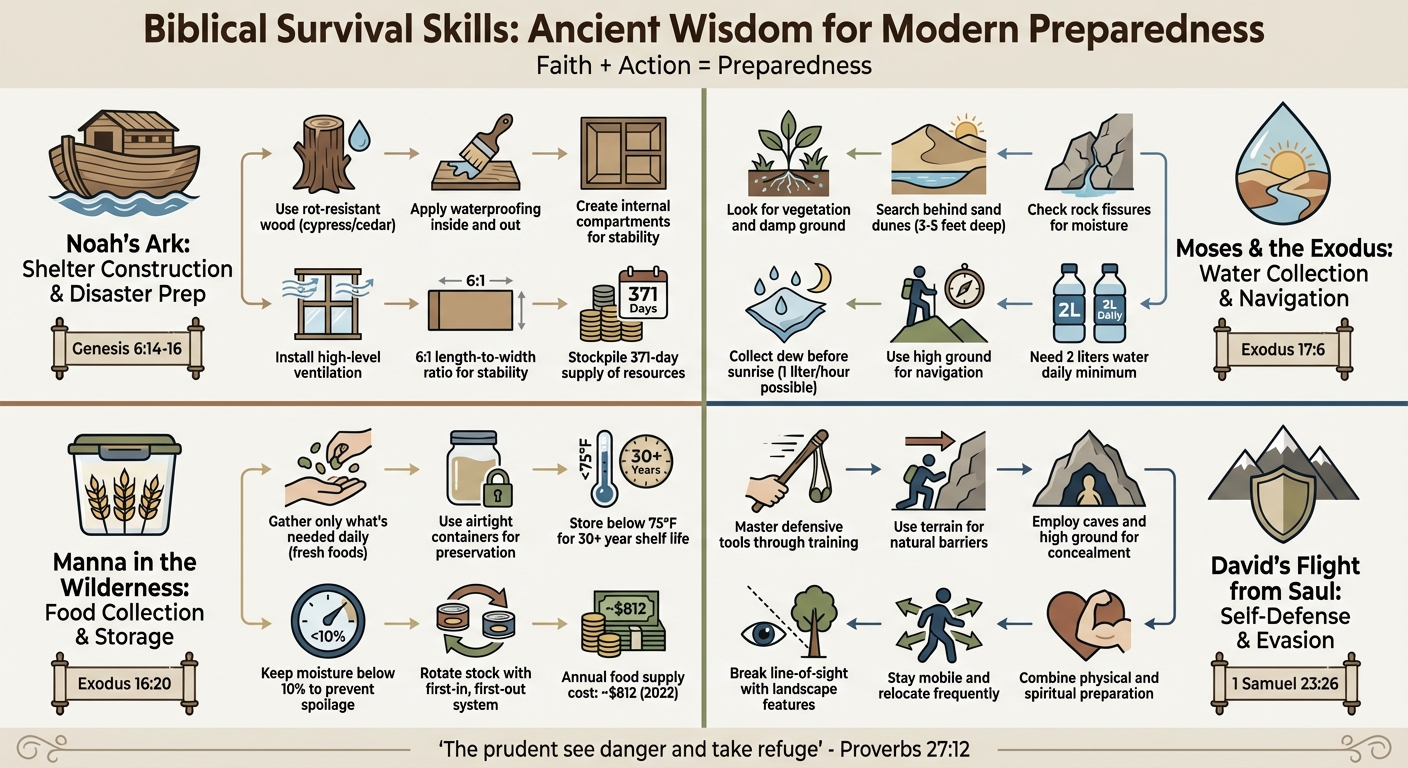 {Biblical Survival Lessons: 4 Ancient Stories with Modern Applications}
The Gospel of Survival. A Biblical Guide to Survival and Preparedness.
Noah's Ark: Shelter Construction and Disaster Preparation
Genesis 6:14–16 offers detailed instructions for building Noah's Ark, which align closely with modern principles of shelter construction. God directed Noah to use gopher wood (believed to be cypress or cedar), apply pitch inside and out for waterproofing, create internal rooms, and include ventilation near the top. The Ark’s dimensions - 300 cubits long, 50 cubits wide, and 30 cubits high (roughly 510 feet by 85 feet by 51 feet) - follow a 6:1 length-to-width ratio. This ratio is recognized today by naval architects as ideal for stability in turbulent waters.
A full-scale replica in Williamstown, Kentucky, demonstrates how these ancient guidelines translate into practical, durable construction. These same principles can also inspire modern shelter designs, particularly for disaster preparedness.
How to Apply Shelter-Building Methods
The Ark’s construction reveals practical techniques for creating strong and reliable shelters. For example, applying marine-grade sealants to both the interior and exterior ensures a solid moisture barrier.
Compartmentalization is another key takeaway. The directive to "make rooms" (or "nests") not only organized the space but also reinforced the structure, making it more resistant to external forces. When building emergency shelters, consider adding internal walls or partitions to improve stability and distribute load.
Material choice is equally important. Woods like cypress and cedar, likely candidates for "gopher wood", are naturally resistant to water damage and pests. For temporary shelters, heavy-duty tarps and waterproof materials from suppliers like AgentXSurvival can serve as effective substitutes.
Ventilation plays a crucial role too. High-level vents prevent moisture buildup and help regulate temperature. Installing roof vents or adjustable openings can improve airflow, especially during storms.
The Ark’s design also highlights the importance of long-term preparation beyond just physical construction.
Flood Preparation and Stockpiling Resources
Building a durable shelter is only part of the equation. Noah’s story emphasizes the need for long-term resource planning. Genesis 6:21 instructs, "You are to take every kind of food that is to be eaten and store it away as food for you and for them". This wasn’t a short-term plan - Noah and his family lived on the Ark for 371 days, showing the need to prepare for extended emergencies.
Modern disaster preparation should follow this example. Create a pantry and water storage system capable of sustaining your household for at least a year. Stock a variety of foods, as Noah did, and include heirloom seeds for post-crisis rebuilding - a nod to the biblical directive to "replenish the earth".
Proverbs 21:20 reinforces this wisdom: "The wise store up choice food and olive oil, but fools gulp theirs down". In addition to food and water, stockpile essential tools like gardening supplies, first aid kits, and bushcraft gear to assist in recovery efforts. Spiritual resilience is also crucial - consider adding a compact Bible or printed scriptures to your emergency supplies.
Key survival strategies inspired by the Ark’s design include:
| Biblical Principle | Modern Application |
|---|---|
| Gopher Wood | Use rot-resistant timber (e.g., cedar, cypress) or treated lumber |
| Pitch Within and Without | Apply waterproofing materials like marine-grade sealants or bitumen |
| Internal Rooms | Add load-bearing partitions for strength and organization |
| 6:1 Proportions | Design shelters with ratios that enhance stability |
| High Ventilation | Install roof vents to improve airflow and prevent water entry |
| 371-Day Supply | Prepare for long-term emergencies with ample resources |
Moses and the Exodus: Water Collection and Wilderness Navigation
The Israelites' 40-year journey through the Sinai desert was more than a test of faith - it was a masterclass in survival. They had to master two skills vital for enduring harsh conditions: finding water in desolate landscapes and navigating unfamiliar terrain. These ancient experiences provide lessons that remain practical for modern survivalists.
When the Israelites arrived at Horeb and found no water, God directed Moses to strike a specific rock, which then released enough water for the entire camp (Exodus 17:6). This wasn’t a random miracle - the rock’s placement at the base of a cliff aligns with modern geological knowledge. Water often collects in crevices, at cliff bases, or in depressions behind sand dunes. Even today, wilderness experts look for similar indicators, including bird droppings around rock formations, which can signal hidden water sources.
The importance of water can’t be overstated. Without it, survival time plummets - from about 100 hours in moderate temperatures to as little as seven hours in extreme desert heat. Claude Piantadosi, author of The Biology of Human Survival, explains:
"Sustained high sweat rates can reduce estimated survival time without drinking water to as little as seven hours."
Moses’s staff, used to access water, underscores the effectiveness of simple tools. Basic items like digging implements, absorbent cloths, and portable water filters can make all the difference. Companies like AgentXSurvival even offer modern filtration systems that turn questionable water into safe drinking supplies.
How to Find Water in Difficult Terrain
In arid environments, knowing where to look for water is crucial. Here are some practical methods:
- Look for green vegetation and damp ground. These often indicate water close to the surface. Digging a few feet in dry riverbeds or at the base of cliffs can yield water.
- Search behind the first sand dune near a beach. Digging 3–5 feet down often reaches fresh water filtered through the sand.
- Utilize narrow rock fissures. Insert a cloth to absorb trapped moisture, then wring it into a container.
- Before sunrise, check for dew on non-poisonous plants or condensation on metal surfaces. You can also tie cloths around your ankles, walk through tall grass, and wring out the moisture - this method can produce up to a liter of water per hour.
Animal behavior also provides valuable clues. Listen for the sound of running water, which can carry over long distances. Watch for insects or birds, especially in the morning and evening, as they often congregate near water. Additionally, animal tracks leading downhill frequently point toward water sources.
No matter the source - whether rock seeps, dew, or streams - it’s critical to purify the water before drinking. The story of Marah (Exodus 15:23-25), where bitter water was made drinkable, reinforces this principle. Modern tools like portable filters and chemical purifiers can help ensure safety, and suppliers like AgentXSurvival provide equipment designed for these exact needs.
Using Landmarks and Natural Signs for Navigation
Finding water is only part of the equation. Navigating through unfamiliar terrain is just as vital. The Israelites relied on divine guidance - a pillar of cloud by day and a pillar of fire by night - to steer them safely through the wilderness (Exodus 13:21-22). Modern survivalists can achieve similar results by identifying and using consistent reference points, such as prominent rock formations, unique trees, or mountain peaks.
Moses also demonstrated the value of high ground during the battle of Rephidim (Exodus 17:9-10). Elevated vantage points provide a strategic overview of the terrain, helping you spot water sources, plan routes, and identify potential dangers long before encountering them.
Environmental markers also play a key role. For instance, when the Israelites reached Elim, they discovered 70 palm trees and 12 springs (Exodus 15:27). In barren landscapes, lush vegetation like palm trees often signals a reliable water source. Combining these biological cues with topographical knowledge - such as following valleys and depressions downhill - can guide you to essential resources.
To keep your body functioning properly, you need about two liters of water daily for circulation, digestion, and temperature regulation. Dehydration quickly leads to fatigue and impaired decision-making. By blending ancient wisdom with modern tools - like compasses, GPS devices, and topographical maps - you can navigate challenging landscapes while ensuring access to life-sustaining water. Suppliers like AgentXSurvival provide the gear you need to stay prepared in even the harshest environments.
Manna in the Wilderness: Food Collection and Storage
For 40 years, the Israelites relied on daily manna, a lesson in food sustainability and proper storage practices (Exodus 16:20). The Hebrew name for manna reflects the need to evaluate unfamiliar resources. When some Israelites attempted to store manna overnight, it became "full of maggots" and emitted a foul odor. However, on the sixth day, they gathered a double portion and were instructed to bake or boil it for the Sabbath, showing that proper preparation methods can extend the shelf life of food.
Deuteronomy 8:3 highlights that manna nourished both the body and spirit, while God's provision of quail emphasizes the importance of a balanced diet. These ancient lessons remain relevant for modern survival, encouraging us to identify wild edibles and learn long-term food storage techniques to prevent waste and spoilage.
Identifying and Harvesting Wild Edibles
Beyond shelter and water, the Bible offers practical insights into foraging and food preservation. Just as manna's unique appearance signaled its safety, modern foragers can use physical markers and environmental cues - like dew after rain - to locate wild edibles. Insects and worms, abundant sources of protein, can also be collected during peak conditions.
For protein-rich insects such as ants, termites, beetles, and grubs, avoid those that sting, bite, or display bright colors - these often signal danger. When collecting worms, gather them from damp soil and rinse them in clean water to help purge any impurities before consumption. Crayfish, another excellent protein source, can be found at night or under rocks in streams during the day. Using small bits of offal as bait on a string is an effective way to lure them to shore.
The story of manna teaches the value of gathering only what is needed each day to minimize waste. This approach works well for fresh, perishable foods. However, when surplus resources become available, modern storage methods can help preserve these items for much longer periods.
Long-Term Food Storage Methods
The Israelites preserved manna in airtight containers, a method that echoes modern survival storage techniques. Today, staples like beans, wheat, white rice, and pasta can remain viable for over 30 years if stored at temperatures below 75°F.
To ensure long-term preservation, focus on controlling moisture, light, and pests. Using PETE plastic bottles or foil pouches with oxygen absorbers can eliminate foodborne insects and maintain nutritional value. Foods must be thoroughly dried - containing no more than 10% moisture - to avoid botulism poisoning. For instance, non-fat powdered milk can last up to 20 years, dehydrated carrots approximately 10 years, and sugar, when kept dry, has an indefinite shelf life.
Label your storage containers with purchase dates and use a "first-in, first-out" system to rotate your stock. Place newer items behind older ones to ensure nothing goes to waste. As of January 2022, the estimated cost for an adult's year-long food supply was $812.42. Companies like AgentXSurvival offer specialized food storage systems designed for emergency preparedness, helping individuals maintain food security during uncertain times. Ezra Taft Benson, a former U.S. Secretary of Agriculture, captured the importance of this practice:
"The revelation to store food may be as essential to our temporal salvation today as boarding the ark was to the people in the days of Noah."
The lessons from manna serve as timeless reminders of resourcefulness and careful planning, blending faith with practical strategies for food sustainability and preservation.
David's Flight from Saul: Self-Defense and Evasion Methods
When King Saul turned against David, he spent years on the run, evading an army of 3,000 soldiers in the wilderness. The story in 1 Samuel highlights David's two-fold strategy: physical readiness and spiritual reliance. From his mastery of weapons to his use of the landscape for concealment, David's actions offer valuable lessons for self-defense and evasion even today.
David's skill with a sling was unmatched, making it a highly effective weapon. But his survival wasn’t just about combat - it was also about strategy. He relied on scouts to gather intelligence and detect threats early. For example, when pursuing the Amalekites, David attacked at twilight while his enemies were distracted by celebrations. This move underscored the importance of timing and the element of surprise. Before making any major decisions, David sought divine guidance through prayer and the ephod, as described in 1 Samuel. Psalm 144:1 captures this balance between physical and spiritual preparation:
"God... trains my hands for war, and my fingers for battle."
David’s approach combined practical skills with spiritual strength, showing that both were essential for navigating life-threatening situations.
Building Self-Defense Capabilities
The Bible emphasizes the importance of developing both inner strength and physical ability. Being physically prepared not only makes you less of a target but also gives you the stamina to handle emergencies. Proverbs 31:17 reflects this idea:
"She girds herself with strength, and strengthens her arms."
Regular training with defensive tools is critical. Consistent practice builds proficiency, and being attuned to your surroundings can help you recognize danger before it strikes. This mirrors the wisdom found in Proverbs: "The prudent see danger and take refuge". For modern survivalists, platforms like AgentXSurvival provide resources such as Krav Maga training and combat systems tailored for practical scenarios. They also offer tactical gear designed for real-world applications.
Biblical law, such as Exodus 22:2, supports the right to self-defense to protect innocent life. This principle aligns with contemporary self-defense laws that uphold the moral duty to protect oneself and others. Some interpretations challenge the idea of passively cooperating with assailants, arguing that resistance is often necessary to uphold justice and distinguish right from wrong.
While self-defense is the cornerstone, knowing how to evade threats can be just as important.
Evasion and Concealment Tactics
David’s survival often hinged on his ability to use the terrain and stay mobile. He relied on rugged landscapes like the Wilderness of Ziph and the hill country of Maon to create natural barriers against Saul’s forces. When cornered, he took refuge in caves such as Adullam and Engedi, hiding deep within while Saul’s men searched nearby.
David also employed psychological tactics to evade capture. For instance, when trapped in Gath, he pretended to be insane by altering his behavior and marking doorways, convincing King Achish that he was harmless. He avoided walled cities where he could be trapped, and when he learned that the people of Keilah would betray him, he quickly moved his 600 men to the wilderness. As described in 1 Samuel 23:26:
"Saul went on one side of the mountain, and David and his men on the other side of the mountain."
This tactic of breaking line-of-sight by using natural features allowed David to stay ahead of his pursuers. Modern survival strategies echo this approach: identifying backup shelters, planning multiple escape routes, and practicing low-profile living can all increase your chances of evasion. In urban settings, blending in or adopting a non-threatening persona can sometimes be more effective than physical hiding. Constant movement was key to David’s survival - by frequently relocating, he prevented Saul from setting traps or ambushes.
David’s combination of strategic defense and effective evasion demonstrates how biblical stories can provide practical guidance for real-world challenges. His ability to adapt, stay prepared, and rely on both physical and spiritual strength remains a timeless example of resilience and resourcefulness.
How to Build a Faith-Based Survival Kit
A faith-based survival kit combines practical essentials with spiritual grounding, shifting your mindset from fear to trust. Jason, a writer at Prepared and Redeemed, puts it this way:
"We prepare because we trust, not because we fear".
This philosophy turns a survival kit into more than just a collection of emergency supplies - it becomes a tool for ministry, empowering you to help others in times of need. Drawing inspiration from biblical figures like Noah and Moses, who prepared for long challenges, this kit is designed to protect both your physical and spiritual well-being.
The foundation of this kit revolves around three key areas: Body, Soul, and Spirit. While physical resources sustain you, emotional resilience helps manage stress, and spiritual preparation provides peace during chaos. Proverbs 27:12 encapsulates this wisdom:
"The prudent see danger and take refuge, but the simple keep going and pay the penalty".
By addressing these areas, your kit ensures that you’re ready to care for yourself and serve others when disaster strikes. Below, we’ll explore the essential components and spiritual elements that make up a well-rounded, faith-based survival kit.
Core Items for Your Survival Kit
Start with water solutions - the most critical survival need. Use a layered approach: invest in a gravity-fed filter for home use, pack portable water straws for evacuation, and include purification tablets as a backup. To begin, aim for a 30-day supply of food and water, which can cost under $200. Expand your stock gradually and focus on items your family actually eats, rotating them into regular meals to avoid waste.
EMP protection is another important yet often overlooked consideration. About 97% of people don’t have any safeguards for their electronics. Studies show that 85% of modern vehicles could fail during a strong electromagnetic pulse due to their reliance on complex electronics. To shield your devices, use fully enclosed metal containers or specialized EMP cloth that offers up to 98% military-grade protection. Avoid relying on plastic bins, as they provide no protection.
Don’t forget essential items like emergency lighting, medical supplies, and communication tools. Companies like AgentXSurvival offer reliable resources in these categories, including tactical gear, off-grid power solutions, and comprehensive medical kits. Some medical kits even come with life-saving training video courses valued at around $125. Additionally, keep a "Family Preparedness Binder" with copies of critical documents, emergency contact information, and medical details in a portable, easily accessible location.
Adding Spiritual Preparation Elements
While physical items address immediate needs, spiritual preparation ensures you remain emotionally and mentally strong. Without a spiritual anchor, even the best gear may not prevent panic or despair. Include a compact Bible or New Testament, a list of encouraging Scriptures (like Psalm 91, Psalm 46, and Philippians 4:6–7), gospel tracts to share hope, and a prayer journal to record God’s provision. These items offer comfort and stability during challenging times.
Incorporate symbolic items like a small cross to remind yourself of Christ’s sacrifice. Even practical tools can carry spiritual significance: water filtration systems can serve as a reminder of the "Living Water" mentioned in John 4:14, and emergency lights can reflect Christ as the "Light of the World". Memorizing verses such as 1 Corinthians 10:13 and Hebrews 2:18 can provide inner strength when physical resources fall short.
To prepare your family spiritually and mentally, practice "Peace Drills" - simulate emergencies like power outages while using your survival gear, praying together, and reinforcing trust in God. These drills build spiritual resilience before real crises occur. Resources like the Dark Reset blueprint from AgentXSurvival can guide you in developing daily habits such as prayer, Scripture memorization, and fasting, fostering greater dependence on God. As Proverbs 21:31 reminds us:
"The horse is prepared for the day of battle, But the victory belongs to the Lord".
Conclusion
Biblical stories provide more than spiritual inspiration - they offer practical lessons for navigating modern challenges. These accounts emphasize the importance of pairing faith with action, showing that trust in God and preparedness go hand in hand. As James 2:26 says:
"For as the body without the spirit is dead, so faith without works is dead also."
This principle encourages us to take tangible steps, like setting aside resources during times of plenty to prepare for scarcity. Applying methods such as the PACE approach (Primary, Alternate, Contingency, Emergency) helps diversify and secure your resources. Regularly practicing survival skills ensures you’re ready when disaster strikes. These strategies illustrate how combining faith with practical action creates a well-rounded survival plan.
The key takeaway is finding the balance between trusting in divine provision and taking responsibility for preparedness. Gene from Basic Training Bible Ministries captures this balance perfectly:
"Safety can limit miracles; risk opens the door to divine intervention."
Prepare with confidence in God's care while equipping yourself with the necessary skills and supplies. A comprehensive plan includes practical elements - like securing shelter, water, food, and self-defense - alongside spiritual readiness. For more resources on tactical gear, off-grid systems, and faith-based survival strategies, visit AgentXSurvival (https://agentxsurvival.com). Remember, preparation isn’t driven by fear but by obedience and a commitment to helping others in times of need.
FAQs
Noah’s Ark isn’t just a biblical tale - it’s a blueprint for creating a sturdy, weather-resistant shelter using limited resources. The Ark was built from durable wood and sealed with pitch to keep water out, while its interior was divided into sections to organize supplies and provide space for its occupants. Similarly, when constructing a modern shelter, think about using rot-resistant materials like pressure-treated wood or metal, applying waterproofing methods like tarps or sealants, and designing a layout with distinct areas for sleeping, storage, and sanitation.
Picking the right location is just as critical. Steer clear of flood zones, steep inclines, or areas prone to falling debris. Aim for a shelter size that’s snug enough to retain heat but spacious enough for your group. Start with materials you can find locally, such as timber or pallets, and if needed, begin with a temporary structure like a debris hut before transitioning to something more permanent.
Your shelter should function as your survival hub. Strengthen it with modern waterproofing, and make sure it’s stocked with essentials like food, water, first-aid supplies, and tools. For more expert tips, gear suggestions, and in-depth survival guides, visit AgentXSurvival.
The story of Moses in the wilderness offers useful insights for survival, especially when it comes to finding and purifying water. For instance, Moses made the bitter water at Marah drinkable and drew water from a rock in Horeb. These events can inspire practical approaches for those navigating modern survival challenges.
To locate water, pay attention to natural signs. Greener vegetation, animal tracks, and the presence of insects often indicate nearby water sources. In arid regions, water may be hiding in low-lying areas or beneath dry riverbeds. You can also gather water from rain, morning dew, or melting snow. Another option is a solar still, which uses clear plastic to trap condensation - a simple yet effective technique.
Once you've found water, purification becomes essential. Boiling is one of the most reliable methods; bring the water to a rolling boil for at least one minute (and longer if you're at higher altitudes). If boiling isn’t an option, you can create an improvised filter by layering crushed charcoal, sand, and cloth to remove some impurities. Chemical treatments, such as iodine or chlorine, and portable UV purifiers are also effective tools. When none of these are available, let the water sit for 24 hours after filtering to allow sediment to settle, then carefully pour off the clearer top layer. By combining smart water-finding techniques with purification strategies, you can stay hydrated and safe in the wild.
David’s escape from King Saul showcases a masterclass in survival and tactical evasion. By leveraging his understanding of the terrain, staying out of sight, and choosing the right moments to act, he consistently stayed one step ahead of his pursuers. His approach highlights essential survival principles: awareness of surroundings, using the environment to your advantage, and mental strength supported by unwavering faith.
These principles remain relevant today. Developing skills like altering your routines, blending into your environment, and interpreting subtle changes in your surroundings can significantly improve your ability to avoid danger. Combining this mindset with versatile, lightweight gear - like compact navigation tools or emergency food supplies - helps ensure you're ready for unexpected challenges. Striking a balance between physical preparedness and mental resilience, much like David did, serves as a timeless guide for anyone aiming to master the art of survival.